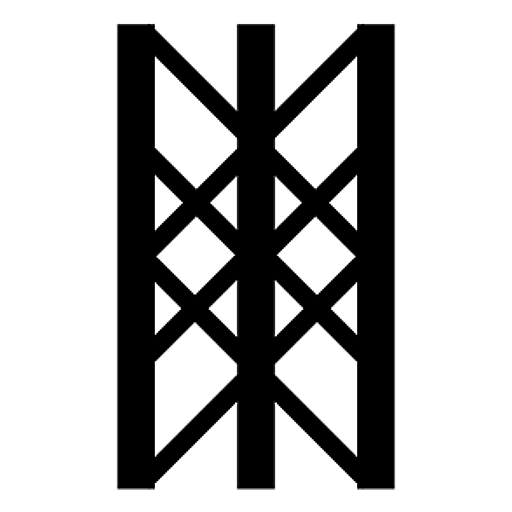
The Web of Wyrd is a modern symbol that represents the Norse concept of fate, woven by the Norns. Composed of nine lines, it is said to contain all runic possibilities within its grid.
What is the Web of Wyrd?
The Web of Wyrd, or the Net of Fate, is a visually complex symbol formed of nine lines intersecting in a grid pattern: three vertical, three horizontal, and three diagonal. This arrangement is thought to encapsulate the entirety of the Elder Futhark rune set, with every rune shape possible to trace within the matrix.
While the grid itself is modern, it is inspired by the ancient Norse concept of 'wyrd' or fate, akin to the web woven by the Norns — Urðr, Verðandi, and Skuld — who dwell at the roots of Yggdrasil, the World Tree. This concept suggests that fate is not linear but a complex, interconnected tapestry.
Origin & History
The Web of Wyrd is a modern creation, emerging in neopagan and Asatru circles in the late 20th century. It is not found in any Viking-age artifacts, nor is it mentioned in any historical manuscripts, runestones, or sagas. No evidence places it in the time of the Vikings. This distinguishes it sharply from symbols with genuine ancient roots.
Many mistakenly market the Web of Wyrd as ancient or Viking, but it holds no such historical claim. The notion that it contains all runes stems from a modern interpretation rather than any archaeological or textual evidence. The grid serves as a metaphor for the potentialities of fate as imagined within modern spiritual contexts.
The Nine Lines and Woven Fate
The composition of the Web of Wyrd as nine intersecting lines — three vertical, three horizontal, and three diagonal — is a deliberate structure. This configuration is said to embrace the full spectrum of the Elder Futhark, though this idea is modern. Each line represents a possible thread in the loom of life, intersecting to form the paths of destiny.
In Norse mythology, the concept of fate, or 'wyrd', is deeply embedded in the stories of the Norns. These three beings are said to weave the destinies of gods and men alike, pouring water from the Well of Urðr to nurture the roots of Yggdrasil. This underlying theme of a woven, interconnected fate is genuinely ancient, if the Web of Wyrd's graphical representation is not.
Modern Meaning & Use
In contemporary practice, the Web of Wyrd is embraced by neopagan and Asatru practitioners as a symbol of fate and the interconnected nature of choices. It finds its place in tattoos, amulets, and artworks, often used in rituals and meditations focusing on understanding one's path and potential futures.
The adoption of the Web of Wyrd is part of a broader modern resurgence of interest in Norse mythology and runic symbols. While controversies around authenticity occasionally arise, the symbol's utility in personal spiritual practice remains unaffected by its modern provenance.
Working with the Web of Wyrd
The Web of Wyrd serves as a reflective tool for contemplating fate and choice. Its use in modern practice involves engaging with the symbol's rich metaphorical landscape.
Meditate on it. Contemplate the nine lines and their intersections as symbols of life's complexity.
Sketch it. Draw the grid and meditate on the rune shapes you find within.
Wear it. As a tattoo or pendant, the Web of Wyrd can be a daily reminder of the weave of destiny.
Inscribe it. Use the symbol in rituals or inscribe it on objects for blessing or intention setting.
Visualise it. In meditation, picture the Web of Wyrd as a living, evolving pattern within your life.
As you engage with the Web of Wyrd, focus on clarity and intention. Whether drawn, worn, or visualised, the symbol's strength lies in its representation of life's interconnected tapestry. Charge it with your personal understanding of fate and choice.
Frequently Asked
Is the Web of Wyrd truly an ancient Viking symbol?
No, the Web of Wyrd is a modern creation, with no evidence of its use in the Viking Age. It emerged in late 20th century neopagan circles and does not appear in any ancient Norse sources.
What is the significance of the nine lines?
The nine lines in the Web of Wyrd are a modern design choice, intended to reflect the complexity and interwoven nature of life and fate. This structure allows for all Elder Futhark rune-shapes to be imagined within, but this interpretation is also a modern one.
Can the Web of Wyrd be used in personal rituals?
Yes, it can be a powerful tool in personal spiritual practice. Many use it for meditation on fate, to represent interconnectedness, or to set intentions in rituals.
Does the symbol connect to the Norns?
The concept of 'wyrd' indeed relates to the Norns, the weavers of fate in Norse mythology. While the Web of Wyrd itself is not ancient, its thematic connection to the Norns' tapestry of fate is deliberate.
Is the Web of Wyrd appropriate for tattoos?
Yes, it is a popular choice for tattoos among those interested in Norse mythology and neopaganism. Like any symbol, it is important to understand its modern origins and personal significance before committing to it permanently.
A Free Rune Reading
Cast Three Runes
Three runes drawn at random from the Elder Futhark, in the shape of the Norns — Urðr, Verðandi, Skuld. The same tradition as the Web of Wyrd, written in twenty-four signs.