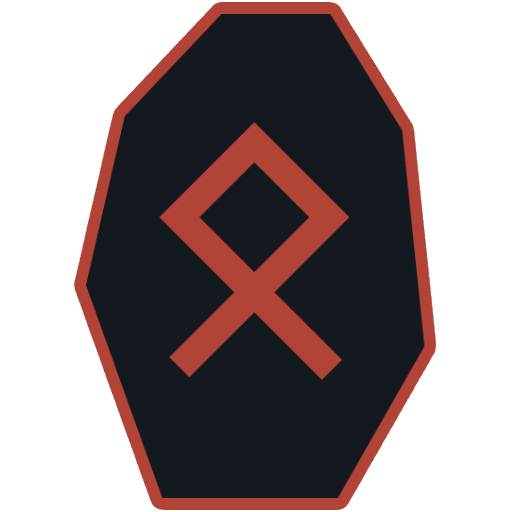
Three runes layered into one — Algiz for sanctuary, Thurisaz for the thorn that turns harm aside, Eihwaz for the world-tree that holds you steady. The protection bind-rune is a guardian's shape: closed against what would take from you, open to what would tend you.
The Components
Three runes, each carrying its own thread into the bind.
A bind-rune is a Norse magical sigil made by layering two or more runes from the Elder Futhark into a single composite glyph. Each component contributes its energy to the working, and the bind itself becomes a single sign that carries the combined meaning. Bind-runes are old — they appear on Viking-era talismans, runestones, weapon-hilts, doorposts and ship-stems — and the practice is still living: rune-workers today design personal binds the same way the carvers did a thousand years ago.
The protection bind-rune presented here weaves three of the runes most associated with safety: Algiz (ᛉ), the rune of sanctuary; Thurisaz (ᚦ), the thorn that turns harm aside; and Eihwaz (ᛇ), the yew tree that holds the world-axis steady when everything around it shakes. Together they form a guardian's shape — not a wall, but a firm ground that stands for what you keep safe.
Why These Three Runes
Algiz is protection itself. Its shape is a hand raised, an antlered head, the open trefoil of a guardian's stance — and across the rune-poem traditions it is consistently described as the rune that wards. Algiz is the first rune anyone reaches for when they want to be defended; in this bind it is the steady centre, the rune everything else braces around.
Thurisaz is sharp and defensive — the thorn, sometimes the giant. Where Algiz says I am safe within, Thurisaz says you do not enter here. In the bind it is the active edge, the rune that meets harm at the boundary and pushes it back. A protection bind-rune without Thurisaz can shelter you; with Thurisaz, it also pushes back.
Eihwaz is the yew tree, the world-tree axis that runs from the underworld up through the heavens. It is the rune of staying upright through what tries to bend you — endurance, immortality (yew-wood does not rot), the long taproot. In a protection bind-rune Eihwaz roots the working: the glyph holds because Eihwaz holds.
How to Use the Protection Bind Rune
Bind-runes are not passive symbols. They work because they are made — drawn, carved, or traced with intention. The making is the magic, not the carved object alone. Traditional ways of working with a protection bind-rune:
Draw it. Sketch the bind on paper, the inside of a notebook cover, a small piece of birch bark. Carry it folded close to you.
Carve it. Wood is traditional — birch, ash, yew. Carve the bind into a small disc; redden the carved lines with red ink to "wake" them, the historical practice.
Wear it. A pendant, a ring, a small leather amulet. The bind sits closer to you than a drawn sigil.
Place it. On a doorpost, a windowsill, the dashboard of a car. Protection binds are traditionally placed at thresholds — the points where what is outside meets what is inside.
Trace it. When you don't have time to make a physical bind, trace it in the air with your finger or breath. The gesture is the working.
In all of these, the rune is "charged" by the act of making and the intention you hold while you make it. Be specific: protection from what? For whom? For how long? A vague intention makes a vague working.
A Note on the Aegishjalmur
The Helm of Awe — Aegishjalmur — is the most famous Norse protection symbol, and you may have seen it: eight Algiz runes radiating from a single centre point. It is sometimes called a bind-rune, but it is more accurately a galdrastafur — a stave, a magical sign. The distinction is small but useful: a bind-rune layers different runes; a stafur often repeats one rune as a geometric pattern.
Both are protective. The Aegishjalmur is older as a named symbol and stronger as a tradition; the protection bind-rune presented here is more flexible. It speaks to a specific quality of protection (sanctuary and defence and endurance) and can be modified by adding or substituting runes for what you actually need.
Make Your Own Variation
The bind above is a tradition-grounded starting point, not a fixed text. Norse rune-workers regularly designed personal binds for their own situation. To make a variation:
Decide what kind of protection. Physical safety? Emotional sanctuary? Protection of a relationship, a home, a journey, a child?
Pick the runes that match. Algiz is almost always present. Pair it with what shapes the protection — Raidho for safe travel, Othala for home protection, Berkano for protecting a child, Tiwaz for protection-by-justice.
Layer the strokes so the runes share lines where they can. Most runes have a vertical stem; bind them along that shared stem. The more elegantly they share, the cleaner the bind feels.
Make it. Carve, draw, or trace it with your specific intention named aloud. Speak the names of the component runes as you draw them.
Historical Context
Protection bind-runes appear across the Viking Age and earlier — carved on rune-stones, on talismans buried with the dead, on objects of daily use. The Eddas and sagas describe runes carved on weapons to make them strike true and on cups to neutralize poison. The tradition is older than the Christian era and continued into folk magic centuries after the official Conversion of Scandinavia. The carvers were not always priests or specialists; runes were a literacy and a working that ordinary households used.
Frequently Asked
Does a protection bind-rune actually do anything?
That depends on what you mean. In the Norse tradition the bind is not a passive charm but a working — it focuses your intention, marks a boundary, and reminds you of what you are guarding. The carving is the magic, not the carved object alone. Many practitioners would say the bind protects because making it is itself an act of protection.
Do I have to use these three runes?
No. Algiz is conventional in protection bind-runes — it is the protection rune — but the other components are flexible. Some protection binds use Algiz alone, or pair it with Tiwaz (justice), Berkano (mothering protection), or Sowilo (the sun's clarity). Pick the runes whose meanings match the protection you actually need.
Can I tattoo a protection bind-rune?
Many people do. A tattoo is the most permanent form of carrying the bind, and it is a reasonable use within the tradition. Choose your runes carefully — a tattoo will outlast most needs, so design a bind whose meaning will still feel right to you in twenty years.
What's the difference between a bind-rune and a sigil?
A sigil is any magical sign with intent behind it — a broad term used across many traditions. A bind-rune is specifically a Norse / Germanic working using runes from the Elder Futhark, drawn from a tradition with its own meanings, mythology, and rules. Bind-runes are a kind of sigil; not all sigils are bind-runes.
A Free Rune Reading
Cast the Runes Behind This Bind
The Protection bind layers Algiz, Thurisaz, and Eihwaz. Cast a reading and see which of those runes — or which others — the Norns turn up.